About OpenAI’s “Breakthrough” on 377 Math problems...
Easy RidersYouTube32,520 views as of 8 October 2026
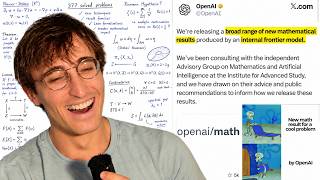
Why it is here
Skeptical take on the release (‘It would have been cool to see how they solve all these problems’); uses the ‘377’ count reported by NYT/Gizmodo rather than the repo’s 372 families. ~32k views. Length 14:36.
Description
Description written by Gemini from the videoGemini 3.8 Flash, 8 October 2026
Summary
The presenter on the Easy Riders channel reviews and critiques OpenAI’s October 6, 2026 release of mathematical results (openai/math repository), which claimed solutions to 377 open problems across 722 manuscripts. He clones the repository into VS Code to inspect the LaTeX preprints and consults Codex on whether OpenAI’s release reveals actionable agent-swarm workflows. Ultimately, he criticizes OpenAI for releasing a massive, unguided paper dump rather than explaining conceptual insights or sharing the underlying multi-agent harness used to generate the proofs.
What is shown
- [00:02] OpenAI’s blog post announcement, “Sharing AI progress in mathematics,” describing results produced by an internal frontier model alongside an advisory group.
- [00:17] OpenAI’s
overview.pdf(“OpenAI Research Catalog”, October 6, 2026) listing 372 result families across 722 manuscripts covering fields like number theory, operator algebras, and mathematical logic. - [02:16] Diagrams illustrating multi-agent research setups (Strategy A, B, C, tracking research attempts with models like Claude Fable 5.1 and Astra).
- [03:07] B-roll footage visiting the tomb of Claude-Louis Navier in Paris.
- [03:35] Cloning the
openai/mathGitHub repository locally using a prompt in a terminal assistant. - [03:41] Exploring the repository inside Visual Studio Code, displaying LaTeX sources (
main.tex,build) alongside compiled PDF preprints (e.g.,four-state-capacity.pdf). - [10:20] Running a query in the VS Code Codex agent asking how to improve an agent-swarm folder structure using OpenAI’s repo; Codex reports the repository is strictly a “publication and proof-artifact collection” providing limited architectural evidence of OpenAI’s internal swarm harness.
- [11:44] The IAS Advisory Group on Mathematics and Artificial Intelligence statement page listing members François Charles, Camillo De Lellis, Timothy Gowers, Martin Hairer, Nikhil Srivastava, Ulrike Tillmann, Ravi Vakil, Edward Witten, and Melanie Matchett Wood.
Claims & numbers
- The presenter notes OpenAI published 372 result families across 722 manuscripts covering roughly 377 open mathematics problems (confirmed in the catalog shown at [00:17] and [03:45]).
- The presenter states he holds a master’s degree in theoretical physics focusing on the AdS/CFT correspondence ([01:58]).
- The Codex tool calculates its own context metrics on screen, noting 29,724 tokens indexed across 71 files and estimated costs for analyzing the local folder ([10:20]).
- The presenter notes a Codex subscription costs $20/month ([10:42]).
- The presenter claims nine prominent mathematicians and physicists form the advisory group consulting on OpenAI’s release ([12:16]).
Notable quotes
- [02:39] “It is pretty mental just how many different fields they’re like tapping into with this... It’s like it’s an expert in every single thing.”
- [10:22] (Codex output read aloud): “The repository is primarily a publication and proof-artifact collection; it provides limited evidence about OpenAI’s internal agent swarm harness.”
- [11:00] “377 maths, I don’t give a fuck, okay? I don’t care that the clankers agree they’ve solved something.”
Assessment
This is a personal commentary and hands-on repository review by an independent creator examining OpenAI’s public release of mathematical proofs. The video features authentic screen recordings of cloning and browsing the official GitHub repository in VS Code alongside original 3D-animated sequences depicting AI agent swarms.
Described by gemini-3.8-flash on 2026-10-08 from the video’s audio and frames.