OpenAI Keeps Claiming They Solved a $1 Million Math Problem. They Didn’t.
FadsYouTube129,712 views as of 8 October 2026
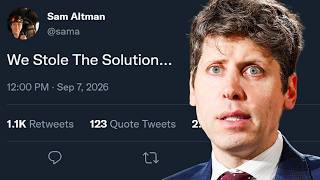
Why it is here
‘OpenAI Keeps Claiming They Solved a $1 Million Math Problem. They Didn’t.’ (Sept 11): ‘1 multibillion ai corp vs 2 humble mathematicians’. ~130k views. Length 7:19.
Description
Description written by Gemini from the videoGemini 3.8 Flash, 8 October 2026
Summary
In this video, creator Fads discusses the controversy surrounding OpenAI’s September 8, 2026 announcement claiming an AI-driven resolution of the Navier–Stokes Millennium Prize problem. He breaks down allegations from mathematicians Tristan Buckmaster and Levent Alpoege that OpenAI leveraged their prior research conducted via OpenAI Codex without proper attribution, while overstating the model’s independent reasoning capabilities.
What is shown
- [00:26] Screenshot of OpenAI’s research publication page titled “On the Navier–Stokes Millennium Prize Problem” dated September 8, 2026.
- [00:39] Graphic of the Clay Mathematics Institute’s 7 Millennium Problems.
- [00:59] Render of fluid dynamics vortex simulation alongside Navier–Stokes differential equations [01:03].
- [01:36] Photos of mathematicians Tristan Buckmaster and Levent Alpoege.
- [01:53] OpenAI Codex product interface screenshot.
- [02:33] TechCrunch article screenshot: “OpenAI fought dirty on career-making math problem, says NYU mathematician” by Russell Brandom.
- [02:43] Photo of OpenAI researcher Sebastian Bubeck alongside leaked chat quotes [02:47].
- [04:02] Tweet screenshot from OpenAI researcher Noam Brown (@polynoamial) on August 28, 2026, stating they had tested Millennium Prize problems without success before throwing massive inference.
- [04:29] Excerpt from OpenAI’s post stating they launched an effort on September 1, 2026, after hearing rumors that two Millennium Prize problems had been resolved.
- [04:53] Quote from Tristan Buckmaster regarding the uniqueness of their approach.
- [05:23] Screenshot of OpenAI’s terms of service regarding data usage for training models on consumer tiers.
- [05:54] OpenAI disclosure text detailing token expenditures for the Navier–Stokes run.
Claims & numbers
- The presenter notes OpenAI announced on September 8, 2026, that 10,000 AI agents running over 4 days proved smooth three-dimensional fluid motion can develop a finite-time singularity under forcing, complete with a formalized proof in Lean.
- The presenter highlights each Millennium Prize problem carries a $1,000,000 reward from the Clay Mathematics Institute.
- The presenter cites mathematicians Tristan Buckmaster and Levent Alpoege, who had spent months using OpenAI Codex as a research assistant, establishing that their work had resided on OpenAI servers before OpenAI announced its own solution.
- The presenter claims OpenAI refused to jointly credit Alpoege because of his affiliation with rival AI company Anthropic.
- Citing OpenAI’s publication text, the presenter notes the agents sent 4.9 million messages and generated ~300 billion output tokens across all tested problems, with 2.7 million messages and ~130 billion output tokens spent specifically on Navier–Stokes.
- The presenter calculates that generating ~130 billion output tokens translates to roughly $10 million to $40 million in compute costs to tackle a $1 million prize problem.
Notable quotes
- [02:47] “Why would you ruin your career? [by making the dispute public] ... If you don’t want me to be nice, then I don’t have to be nice.” (Quoting Sebastian Bubeck from leaked communications)
- [04:55] “Almost nobody else I know of was working on it. It is not the direction one arrives at in a few days by giving a model the problem statement.” (Quoting Tristan Buckmaster)
- [05:58] “It cost them around 130 billion output tokens, which from the estimates I’ve seen is like a lower bound of about $10 million and an upper bound of about $40 million to solve a $1 million problem.” (Presenter Fads at 05:57)
Assessment
This is a critical commentary and news review video by an independent creator examining a public academic dispute and corporate PR announcement. The presenter does not conduct live demonstrations, instead summarizing reporting from TechCrunch, public tweets, and published OpenAI blog materials.
Described by gemini-3.8-flash on 2026-10-08 from the video’s audio and frames.