Oct 6, 2026: A math drop of historic proportions
Alvaro Lozano-RobledoYouTube41,796 views as of 8 October 2026
Why it is here
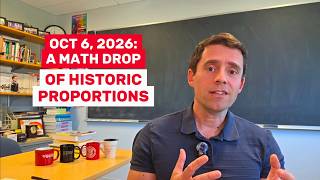
Mathematician Álvaro Lozano-Robledo (UConn): ‘Oct 6, 2026, may be the single most important date in the history of mathematics so far due to the staggering drop of results by AI on that date.’ ~41k views. Length 6:34.
Description
Description written by Gemini from the videoGemini 3.8 Flash, 8 October 2026
Summary
Mathematician and professor Alvaro Lozano-Robledo analyzes OpenAI’s massive October 6, 2026 mathematics release, discussing its scale and historical implications for mathematics. He contextualizes the drop within recent AI advances in mathematical problem-solving, outlines the scope of problems addressed, and argues that while AI models are transforming research, human mathematicians remain essential for introducing novel ideas, verifying proofs, and communicating results.
What is shown
- [00:00] Title slide: “OCT 6, 2026: A MATH DROP OF HISTORIC PROPORTIONS” as Lozano-Robledo introduces the topic.
- [00:13] OpenAI publication page overlay: “October 6, 2026 / Sharing AI progress in mathematics”.
- [00:20] Manuscript catalog graphic: “Mathematics manuscript collection: 722 manuscripts covering 372 result families”, followed by a portrait of Leonhard Euler at [00:31].
- [00:39] Lean formalizations README excerpt detailing machine-checked proofs and comparator documentation.
- [01:45] Slide showing OpenAI’s September 8, 2026 paper: “On the Navier–Stokes Millennium Prize Problem”.
- [01:58] Photo overlay titled “The Erdős Breakthrough” referring to the disproof of the Erdős unit distance conjecture.
- [02:18] Article graphic: “OpenAI has solved the Navier–Stokes Millennium problem using $15m of AI effort”.
- [02:27] Article graphic: “ChatGPT Pro 500: What the New $500/Month Plan Actually Gets You”.
- [02:47] Excerpt from OpenAI’s release stating the model was posed ~4,000 problems during evaluation.
- [03:12] Graphics comparing open problems to model results: Riemann Hypothesis vs. Quasi-Riemann Hypothesis [03:12], Hodge Conjecture vs. Hodge for CM abelian varieties [03:18], and Birch and Swinnerton-Dyer Conjecture vs. Goldfeld’s 50-50 conjecture for twists [03:26].
- [03:37] Title page of OpenAI preprint: “The Quasi-Riemann Hypothesis: A Zero-Free Half-Plane Re s > 7/8” (dated 30 September 2026).
Claims & numbers
- The presenter notes that on October 6, 2026, OpenAI published 722 mathematical manuscripts spanning 372 result families ([00:17]).
- The presenter notes OpenAI tested its model against approximately 4,000 open problems to produce the catalog ([02:50]).
- The presenter highlights specific results in the catalog, including a proof of the Quasi-Riemann Hypothesis ($\text{Re}(s) > 7/8$), the Hodge conjecture for CM abelian varieties, the second part of Hilbert’s 16th problem, Hilbert’s 10th over $\mathbb{Q}$, Goldfeld’s 50-50 conjecture for elliptic curve twists, and a new fast integer multiplication algorithm ([01:13], [03:13]).
- The presenter mentions that several papers include formal Lean certificates while others remain unformalized and require human verification ([00:41]).
- The presenter references earlier milestones, stating OpenAI previously applied $15 million in compute to solve the Navier–Stokes Millennium problem in September 2026 and refuted the Erdős unit distance conjecture ([01:45], [02:08]).
- The presenter highlights OpenAI’s top-tier pricing of $500/month for ChatGPT Pro 500 ([02:29]).
Notable quotes
- “October 6th, 2026, may be the single most important day in the entire history of mathematics so far...” — [00:00]
- “This is the equivalent of Euler dropping all of his body of work in one single day.” — [00:31]
- “Are mathematicians cooked? Is the entire mathematics profession over overnight because of this release? No.” — [04:26]
Assessment
This is an independent analysis and commentary video by an academic mathematician evaluating OpenAI’s major research drop. The presenter does not execute code or prove theorems live, but references verified publications, screenshots, and evaluation metrics from OpenAI’s release to contextualize the event.
Described by gemini-3.8-flash on 2026-10-08 from the video’s audio and frames.