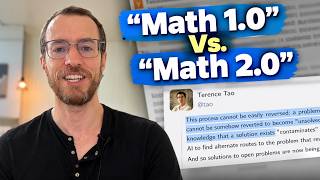
Math 2.0: Terence Tao responds to the recent OpenAI flood of proofs
Dr. Samuel Allen AlexanderYouTube46,354 views as of 10 October 2026
Description
Description written by Gemini from the videoGemini 3.8 Flash, 10 October 2026
Summary
Dr. Samuel Allen Alexander reviews and critiques a Mastodon thread by mathematician Terence Tao regarding the transition from “Math 1.0” to “Math 2.0” following OpenAI’s mass release of AI-generated mathematical proofs. Alexander reads through Tao’s four-part post, debates Tao’s perspectives on the traditional mathematical community and the role of exposition, and subsequently reads and reacts to community commentary from Hacker News.
What is shown
- [00:00] Dr. Samuel Allen Alexander on camera, displaying Terence Tao’s post on Mastodon (
@tao@mathstodon.xyz) regarding traditional mathematics (“Math 1.0”). - [02:42] Displaying part 2 of Tao’s post detailing how AI prompt solving without understanding disrupts the broader mathematical community and leads to research hoarding.
- [05:18] Displaying part 3 of Tao’s post regarding the irreversible nature of problem solving and the unsustainability of large-scale problem harvesting.
- [06:23] Displaying part 4 of Tao’s post defining “Math 2.0”, focusing on exposition, community building, and re-evaluating criteria for academic advancement.
- [08:37] Reading Mastodon user replies to Tao’s post, including reflections on academic reform and “low-hanging fruit.”
- [10:00] Transition to a Hacker News discussion thread titled
"Math 2.0" will need to value mathematical progress more holistically (mathstodon.xyz/tao). - [10:06] Reading Hacker News comments analyzing LLM strengths/weaknesses (comment by
loveparade). - [13:20] Reviewing comment by
fidotrondiscussing tight feedback loops and Lean/proof assistants. - [16:38] Reading comment by
shubhamjainon arbitrary benchmarks versus genuine contributions, and subsequent comments comparing AI math to AI in chess and Go (kuboble). - [20:41] Reading comments discussing verification, human-in-the-loop bottlenecks, and potential obsolescence of human mathematicians (
antman,bsenftner,stared,j-pb). - [34:48] Reading comments discussing the parallels between mathematics and software development in the age of AI agents (
lifesloving,primer42,eSt).
Claims & numbers
- The presenter notes that OpenAI recently released “almost 400 huge math breakthroughs” automated entirely by AI (referencing OpenAI’s October 2026 release of AI-generated proof manuscripts) [00:14].
- The post by Terence Tao is dated October 7, 2026, 02:00 AM (edited at 07:14 AM) [07:32].
- The presenter claims he published a paper in the top journal of mathematical biology that year and did not receive invitations to talk, contrasting his experience with Tao’s description of Math 1.0 [01:49].
- The Hacker News thread shown displays 431 points and 413 comments [10:02].
- Quoting a comment by
curt15, the user cites an estimate of pure math research funding from the US federal budget at “something like $100M annually” [18:48].
Notable quotes
- Dr. Samuel Allen Alexander [00:00]: “The CEO of mathematics, Terence Tao, is replying to the massive flood of mathematical breakthroughs that was published by OpenAI a couple days ago.”
- Terence Tao (read by presenter) [07:05]: “‘Math 2.0’ will need to decenter the role of raw problem solving and value mathematical progress more holistically — for instance by elevating the role of exposition, but also that of community building and opening up new directions of study.”
- Dr. Samuel Allen Alexander [19:11]: “Math is truly an infinite game, whereas Go and chess, they’re very finite... If math were a chessboard, it would be an infinite-dimensional chessboard.”
Assessment
This is a commentary and review video by an independent mathematician discussing Terence Tao’s public response and online forum reactions to OpenAI’s recent release of hundreds of AI-generated mathematical proofs. It presents genuine social media posts and community comments on screen with live analytical commentary rather than demonstrating direct AI tooling or proof generations.
Described by gemini-3.8-flash on 2026-10-10 from the video’s audio and frames.