The world's best mathematicians already overtaken by AI
Sky News · 2026-09-21 · review · 642,142 views
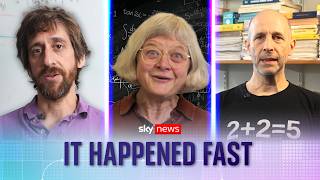
What's in the video
Description written by Gemini, which watched and listened to the whole video.
Summary
This video is a Sky News investigative report presented by technology correspondent Rowland Manthorpe examining the rapid rise of AI capabilities in pure mathematics and its emotional and professional impact on leading mathematicians. It features interviews with prominent mathematicians from Cambridge, Oxford, Stanford, and Imperial College London discussing the speed of AI progress, the loss of human intuition and joy, and the uncertain future of mathematical research.
What is shown
- [00:00] Interviews with mathematicians Kevin Buzzard (Imperial College London), Steven Sivek (Imperial College London), Leslie Ann Goldberg (University of Oxford), Ravi Vakil (Stanford University), and Timothy Gowers (Cambridge University) reflecting on their initial feelings regarding AI progress.
- [00:14] Rowland Manthorpe speaking in an editing studio with mathematical equations on computer monitors.
- [01:22] A social media post from OpenAI announcing an internal model group using approximately 10,000 coordinating AI agents that arrived at a proposed Navier–Stokes Millennium Prize Problem solution in 88 hours.
- [01:32] A benchmark chart from OpenAI plotting pass rates versus test-time compute for GPT-6 Astra against an internal model on a curated set of open math problems.
- [01:58] Leslie Ann Goldberg demonstrating whiteboard work and discussing how generative AI synthesizes human-discovered mathematical methods.
Claims & numbers
- Timothy Gowers states that during the course of the year, AI models evolved from the level of a "mediocre PhD student to very good PhD student, to experienced mathematician level, to top mathematician level" [00:37].
- Rowland Manthorpe notes that a few years prior, AI could barely handle GCSE mathematics, but is now resolving problems mathematicians spent decades attempting [01:15].
- OpenAI's graphic claims an internal model group solved the Navier–Stokes Millennium Prize problem in 88 hours using approximately 10,000 coordinating AI agents [01:23].
- The Navier–Stokes problem had remained unresolved for roughly 90 years, and the Millennium Prize problems comprise seven problems established in 2000 [01:24].
- Kevin Buzzard asserts that in six months' time, AI mathematical systems will be significantly improved and capable of teaching humans [02:53].
Notable quotes
- Timothy Gowers [00:11]: "We're still on the beach, we can see the tsunami, but it hasn't quite reached us yet."
- Leslie Ann Goldberg [02:26]: "To me, it kind of destroys the joy of mathematics."
- Timothy Gowers [04:58]: "And so we may find ourselves with an incredible tool that nobody can use."
Assessment
This is a produced news feature rather than a technical demonstration, combining journalistic commentary with reactions from leading research mathematicians. The technical claims are based on published frontier lab announcements and charts rather than live on-air verification.
Described by gemini-3.8-flash on 2026-10-07 from the video's audio and frames.