Has a Millennium Prize Problem been solved by AI?
Stand-up Maths · 2026-09-21 · review · 1,284,963 views
What's in the video
Description written by Gemini, which watched and listened to the whole video.
Summary
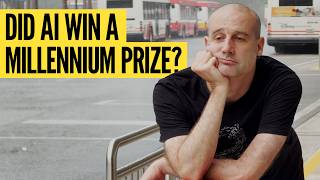
In this video, stand-up mathematician Matt Parker discusses OpenAI’s September 2026 announcement claiming a solution—specifically a finite-time blowup counterexample—to the Navier–Stokes Millennium Prize problem. Filming while visiting Walt Disney World, Parker explains the mathematics behind the Navier–Stokes equations, dissects OpenAI's paper and promotional diagrams, and details the surrounding community drama and debate over AI’s role in pure mathematics.
What is shown
- [00:00] Matt Parker introduces the breaking maths news while walking through Walt Disney World's Magic Kingdom.
- [01:44] Display of the Clay Mathematics Institute’s official Navier–Stokes problem description page authored by Charles Fefferman.
- [02:02] Mathematical breakdown of the Navier–Stokes equations on screen, examining velocity, pressure, viscosity, and acceleration terms.
- [06:03] Explanation of Statement (C) of the Clay Millennium Prize formulation: proving breakdown of solutions on $\mathbb{R}^3$ with smooth external force in finite time.
- [07:25] Walkthrough of OpenAI's official announcement page ("On the Navier-Stokes Millennium Prize Problem", Sept 8, 2026), highlighting the viral spiral diagram and pointing out it is a stylized PR graphic rather than a rigorous visualization.
- [09:38] Review of OpenAI's technical preprint ("Finite Time Blowup for Navier-Stokes"), examining Figure 1's schematic evolution of the inner core towards singularity at $t = 1$.
- [10:53] Parker demonstrates his own animated 3D simulation showing the inward spiral, axial stretching, and rapid increase in angular velocity as time parameter $\tau = 1 - t$ approaches zero.
- [13:10] Breakdown of the preprint's construction involving a sequence of spatially oscillatory velocity pulses to keep the required external force smooth.
- [14:00] Timeline of the academic drama: Mastodon posts by human mathematicians Levent Alpoge and Tristan Buckmaster detailing their independent Euler equation results, followed by OpenAI's announcement.
- [14:55] Breakdown of reported compute metrics for OpenAI's run (10,000 agents, 2.7M messages, 130B tokens, estimated $10M–$40M cost).
- [17:48] Commentary in front of Epcot discussing the philosophy of mathematical inquiry, referencing 3Blue1Brown (Grant Sanderson), Terence Tao, Galois theory, and the value of human understanding versus brute-force counterexamples.
- [19:57] Screenshots of community verification efforts and discussions from Reddit (/r/FluidMechanics) and GitHub analyzing physical invalidity (vaporization).
Claims & numbers
- The presenter notes the Millennium Prize problems were established in 2000 by the Clay Mathematics Institute with seven problems and a $1 million prize each, of which only one had previously been solved (the Poincaré conjecture).
- The presenter notes that OpenAI claimed to have established Statement (C) of the problem on $\mathbb{R}^3$ with $n = 3$ and viscosity $\nu > 0$, constructing a smooth divergence-free initial vector field and smooth forcing term producing a finite-time singularity.
- In the OpenAI construction, the singularity occurs at $t = 1$, where $\tau = 1 - t$ approaches 0, and the core aspect ratio parameter $h$ is strictly bounded below $1/100$.
- The presenter states OpenAI reported that its system coordinated 10,000 AI agents that exchanged 2.7 million messages and generated approximately 130 billion output tokens.
- The presenter cites online community estimates calculating that the compute required for OpenAI's run cost between $10 million and $40 million.
- The presenter cites community fluid dynamics calculations indicating that any physical fluid modeled by the scenario would vaporize long before reaching the singularity point.
Notable quotes
- [00:06] "The point is we now have a Millennium maths problem solution, and normally when these things are announced and I have to respond quickly, I'm on vacation at the beach."
- [08:56] "However, it is a PR image. There's no code that gives you this, it's not a 3D model that was part of the proof, it doesn't actually appear in the proof at all."
- [18:06] "The journey is the experience. And we're going to miss out on a lot of maths if we don't do that journey."
Assessment
This is an independent educational commentary and review video by Matt Parker analyzing a major AI-assisted mathematical breakthrough and the ensuing controversy. The presenter uses clear on-screen excerpts from primary source documents, preprints, and custom mathematical animations to clearly differentiate actual preprint findings from marketing visuals.
Described by gemini-3.8-flash on 2026-10-07 from the video's audio and frames.