OpenAI’s secret model just BROKE math...
Wes RothYouTube132,707 views as of 8 October 2026
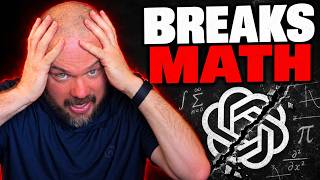
Why it is here
Wes Roth on the Oct 6 release: ‘OpenAI just released 722 mathematical manuscripts from an unreleased AI model’, arguing that verification may become the bottleneck. ~133k views. Length 21:44.
Description
Description written by Gemini from the videoGemini 3.8 Flash, 8 October 2026
Summary
Wes Roth discusses OpenAI’s October 6, 2026 publication of 722 mathematical manuscripts generated by an unreleased internal frontier model. He analyzes how the model tackled major open mathematical conjectures, contextualizes the accelerating pace of AI math discoveries, and explores the wider debate across the mathematics community regarding AI verification and human oversight.
What is shown
- [00:00] OpenAI blog post titled “Sharing AI progress in mathematics” dated October 6, 2026, announcing results from an internal frontier model.
- [02:10] GitHub repository page (
openai/math) detailing 722 manuscripts grouped into 372 result families alongside Lean formalizations. - [04:21] Summary list of specific open problems tackled by the model, including the quasi-Riemann hypothesis, the Birch–Swinnerton-Dyer conjecture, and Goldfeld’s conjecture.
- [05:22] A whiteboard diagram illustrating progress toward mathematical bounds using a mountain-climbing analogy.
- [10:02] An X (Twitter) profile page for OpenAI researcher
roon(@tszzl). - [10:58] A sketch illustrating the monthly scaling rate of AI-generated mathematical manuscripts (from 10 in August to 100+ in September, to 722 in October).
- [14:10] Scott Aaronson’s blog post (Shtetl-Optimized, October 4, 2026) titled “My new course at UT Austin: AI Alignment Theory”, discussing the reaction of the mathematical community to rapid AI progress.
Claims & numbers
- The presenter notes that OpenAI published 722 mathematical manuscripts across 372 families spanning 17 mathematical and scientific disciplines on October 6, 2026.
- The presenter notes that the average mathematical result required roughly the equivalent compute of 3 hours of “ChatGPT Pro thinking”.
- The presenter states that OpenAI’s output of mathematical results has scaled roughly 10x per month (approximately 10 results published in August, 100+ in September, and 722 in early October).
- The presenter highlights specific claimed results, including establishing an unconditionally proven zero-free region boundary of 0.875 for the quasi-Riemann hypothesis (improving upon earlier human work toward the 0.5 critical line).
- The presenter mentions that 25 Fields Medalists signed an open letter addressing AI’s disruptive impact on the mathematical research landscape.
Notable quotes
- [02:03] “Math just became an industrial process.”
- [07:38] “Notice math is moving from ‘can we prove it?’ to ‘can we check it? Can we understand it?’”
- [19:45] “How we’re going to approach dealing with this AI factory producing math... will lay some of the groundwork, I think, for when the other industries, when the AI will reach the very frontier of those industries.”
Assessment
This is an independent commentary and news review analyzing an official announcement and GitHub repository release from OpenAI. The video relies on genuine published web pages, blog posts, and community discussions, accompanied by the presenter’s custom whiteboard sketches and editorial analogies.
Described by gemini-3.8-flash on 2026-10-08 from the video’s audio and frames.